
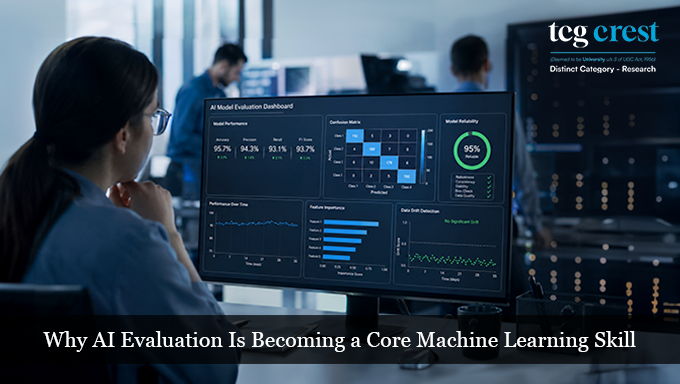
Why AI Evaluation Is Becoming a Core Machine Learning Skill?
Building a model that works in a notebook is easy. Building one that survives real users, real data, and real deadlines is a completely different challenge. Too many machine learning teams still celebrate a good accuracy score and call it a day, only to watch that same model fall apart within weeks of deployment. Research shows enterprise AI failure rates ranging from 70% to 95% across enterprise environments, and a huge share of that damage comes from skipping proper evaluation.
Building a model that works in a notebook is easy. Building one that survives real users, real data, and real deadlines is a completely different challenge. Too many machine learning teams still celebrate a good accuracy score and call it a day, only to watch that same model fall apart within weeks of deployment. Research shows enterprise AI failure rates ranging from 70% to 95% across enterprise environments, and a huge share of that damage comes from skipping proper evaluation. This blog explains why AI evaluation has quietly become one of the most valuable skills in machine learning, more valuable in many cases than model-building itself. If you are exploring an MSc Machine Learning in Kolkata, understanding this shift matters for your career, not just your coursework. Keep reading to see exactly what modern evaluation looks like and why it decides whether your model actually ships.
Why Accuracy, Precision, and Recall Are No Longer Enough
Every machine learning course starts with accuracy, precision, and recall, and these metrics still matter. But they were designed for a world of static datasets and clean test splits, not the messy, evolving conditions of production systems. This section breaks down where these classic metrics fall short and what fills the gap.
The Limits of Classic Metrics
A model with 95% accuracy on a benchmark can still behave erratically once real users start typing weird queries, uploading strange files, or triggering edge cases nobody anticipated. Precision and recall measure performance on a fixed snapshot of data. They say nothing about how a model behaves when the data distribution shifts, when inputs get noisy, or when the model is chained into a larger autonomous pipeline. Why is AI evaluation becoming more important than raw model accuracy? Because production environments are dynamic, and a model that only performs well under lab conditions is a liability the moment it meets unpredictable real-world traffic.
What Broader Evaluation Actually Covers
Modern AI evaluation stretches across robustness testing, hallucination detection, uncertainty quantification, agent trajectory evaluation, tool-use reliability, long-horizon task assessment, failure recovery, and behavioural evaluation. Each of these answers a question that accuracy alone cannot. Does the model stay stable when inputs get messy? Does it know when it is unsure? Does it recover gracefully when something breaks mid-task? Machine learning programmes that teach evaluation as its own discipline, not as a side note after model training, are producing graduates who can actually ship dependable systems.
Robustness Testing: Preparing Models for Messy Real-World Data
Clean training data is a luxury that production systems rarely get. This section explains why robustness has become a headline skill for machine learning engineers in 2026.
What Robustness Actually Means in Practice
Robustness testing checks whether a model keeps performing when inputs drift away from the tidy conditions it was trained on. Typos, code-switched Hindi-English phrasing, blurry images, and slightly reworded questions are all part of everyday reality for any deployed system. A model that only performs well on textbook-clean data will crumble the moment actual users start interacting with it. Engineering teams now deliberately stress-test models with noisy, boundary-case, and adversarial inputs long before deployment day arrives.
The Coordination Problem Multiplying the Risk
This challenge grows sharper as AI agents multiply across organizations. Belitsoft's 2026 research found companies now run an average of 12 AI agents, but half of them operate without connecting to other agents, which limits coordination and robustness. A robust system does not just survive unusual inputs; it survives messy interactions with other systems too. Robustness has moved from being a nice-to-have research topic to a mandatory module inside any serious deep learning and reinforcement learning curriculum, because employers now expect graduates to test for failure, not just for success.
Hallucination and Uncertainty: Teaching Models to Know Their Limits
Confident wrong answers cause more damage than honest uncertainty ever will. This section unpacks two evaluation skills that have become non-negotiable across the machine learning industry.
Catching Hallucinations Before They Reach Users
Large language models and generative AI systems can produce fluent, convincing, completely false outputs. MIT research indicates that 95% of enterprise AI pilots deliver zero measurable financial return, and trust failures caused by unchecked hallucinations sit at the center of that statistic. Engineering teams now rely on factual consistency scoring, retrieval-grounded verification, and citation-checking pipelines that compare outputs against a trusted source before anything reaches a user. Some teams even run a second model purely as a fact-checker for the first, a technique commonly called LLM-as-judge.
Uncertainty Quantification and Calibrated Confidence
Uncertainty quantification solves a related but distinct problem. It teaches a model to output a confidence score that honestly reflects how sure it actually is, instead of guessing with false conviction. This calibrated confidence lets engineers set thresholds so low-confidence outputs get escalated to a human reviewer automatically. Machine learning graduates who understand probability, calibration, and statistical modeling at this depth are exactly the profile employers are chasing right now.
Agent Trajectory Evaluation and Long-Horizon Task Assessment
Modern machine learning does not stop at single predictions anymore. This section covers how evaluation has expanded to judge entire sequences of decisions, not just final outputs.
Judging the Path, Not Just the Destination
Agent trajectory evaluation checks every step an autonomous system takes to reach its answer, not just whether the final answer looks correct. An agent booking a flight or filing a report might land on the right outcome through a risky shortcut or an unauthorized action along the way. Evaluating only the final result misses that entirely, which is exactly why trajectory-level auditing has become central to agentic AI engineering. Gartner projects agentic AI spending will reach $201.9 billion in 2026, a 141% jump from 2025, yet only 11% of intended agentic use cases from the previous year actually reached production, largely because trajectory-level risks went unchecked.
Why Long-Horizon Tasks Need Different Evaluation Entirely
Long-horizon task assessment evaluates how well a system holds context, plans multiple steps ahead, and avoids compounding small errors into large ones over an extended workflow. A model can nail a single-step task and still fail badly on a ten-step process where an early mistake snowballs. Carnegie Mellon's The Agent Company benchmark found that even top-performing agent models complete just 30.3% of real-world office tasks, a clear signal that long-horizon reliability remains an unsolved and heavily researched problem in machine learning today.
Tool Use, Failure Recovery, and Behavioural Evaluation
Machine learning models rarely operate in isolation anymore. This section explains what happens when models start calling tools, taking actions, and interacting with other software.
Tool-Use Reliability in Connected Systems
Tool-use reliability checks whether a model or agent selects the correct API, database, or external tool, and whether it handles unexpected responses sensibly. Research synthesizing findings from Carnegie Mellon, MIT, and RAND identifies communication success rates as low as 29% and navigation failure rates of 12% among the core reasons agents fail once deployed. How does failure recovery improve machine learning system reliability? It means designing systems that detect a failed step, retry intelligently, fall back to an alternative approach, or hand control back to a human instead of looping endlessly or producing silent garbage output.
Behavioural Evaluation as the Final Layer
Behavioural evaluation examines how a system acts under pressure, ambiguity, or adversarial manipulation, essentially red-teaming the model before real users or attackers get the chance. CrewAI's 2026 survey of enterprise executives found that 34% cite security and governance as the top evaluation factor for agentic platforms, ranking above raw performance metrics. This is precisely why responsible AI and governance-focused evaluation now sit at the core of applied machine learning education rather than at its margins.
Why This Shift Matters for Machine Learning Education in Kolkata
The talent gap around evaluation is real and growing fast. This section connects everything discussed above to what a genuinely future-ready ML programme needs to prioritize.
The Widening Skills Gap Industry Data Reveals
Industry data shows 94% of engineering leaders report critical gaps in agentic AI expertise, and LinkedIn's January 2026 survey found 84% of Indian professionals feel unprepared for AI-driven hiring even as 87% comfortably use AI at work. India currently commands 16% of the global AI talent pool, expected to touch 1.25 million professionals by 2027, yet raw model-building skill is no longer the differentiator employers look for.
What a Research-Driven Curriculum Should Prioritize
A genuinely competitive MSc in Machine Learning in Kolkata now needs to teach robustness, hallucination detection, uncertainty quantification, trajectory evaluation, tool-use reliability, and behavioural testing as one connected discipline, not as scattered electives. Programmes anchored in a research-oriented curriculum with a faculty-supervised capstone give students the chance to build and evaluate end-to-end systems under the same rigour as a genuine research thesis, rather than stopping at a leaderboard score.
Conclusion
Machine learning is no longer just about training a model that performs well on a test set. It is about engineering a system that survives messy data, admits uncertainty honestly, recovers from failure gracefully, and holds up under adversarial pressure. The statistics are hard to ignore: sky-high failure rates, stalled agentic pilots, and persistent skills gaps all point to evaluation as the missing piece in most machine learning education today. As agentic AI, autonomous systems, and generative AI become standard infrastructure across Indian industries, the engineers who treat evaluation as seriously as model architecture will be the ones building systems people can actually rely on.
Ready to Build Machine Learning Skills That Actually Hold Up? Join TCG Crest University's FIAA programme
If this breakdown of evaluation, robustness, and reliability engineering resonates with where you want your career to go, TCG CREST University's research-driven, one-year postgraduate programme with a faculty-supervised capstone is built exactly for this shift. Its curriculum moves through core machine learning foundations into applied evaluation, autonomous agents, and end-to-end system building, all under real research rigour, at its Kolkata campus. With a September 2026 cohort now open for admissions, TCG CREST University offers a genuinely hands-on path into the evaluation-first skill set employers are actively hiring for. Explore the curriculum at TCG CREST University and see where you fit.
Frequently Asked Questions (FAQs)
1. Why is AI evaluation considered a core machine learning skill in 2026?
Because production systems fail more often from poor evaluation than poor models. Robustness, uncertainty, and trajectory checks now decide whether a system actually ships successfully.
2. What is the difference between accuracy and reliability in machine learning?
Accuracy measures performance on a fixed test set. Reliability measures consistent, safe behaviour across messy, unpredictable, real-world conditions over time.
3. How does uncertainty quantification help machine learning systems?
It lets a model flag genuine doubt instead of guessing confidently. Low-confidence outputs get escalated to human review, preventing silent, costly errors.
4. What is agent trajectory evaluation in machine learning?
It examines every step an autonomous system takes toward an answer, not just the final output, catching risky shortcuts or unauthorized actions along the way.
5. Does an MSc Machine Learning programme in Kolkata need to teach evaluation skills?
Yes. Employers increasingly prioritize evaluation expertise over pure model-building skill, making it essential for any competitive machine learning curriculum today.